
If you’ve started planning a modular kitchen in Udaipur, chances are you’ve already come across these two layouts — the L-shape and the U-shape. And chances are, you’re a little confused about which one to go with.
Don’t worry. You’re not alone.
Most homeowners walk into our showroom having already Googled both layouts, watched a few YouTube videos, and still feel unsure. Because the truth is, the “best” kitchen layout isn’t a universal answer — it depends entirely on your kitchen’s size, the way your family cooks, and yes, even the kind of home you live in.
Udaipur homes, in particular, have some characteristics worth paying attention to. Whether you’re in a 2BHK apartment in Hiran Magri, a villa in Shobhagpura, or a builder flat near Bhuwana, the layout that works beautifully in a Delhi apartment might feel cramped or wasteful in your space.
So let’s actually break this down — practically, honestly, and without the usual fluff.
First, Let’s Understand What These Layouts Actually Are
The L-Shape Kitchen
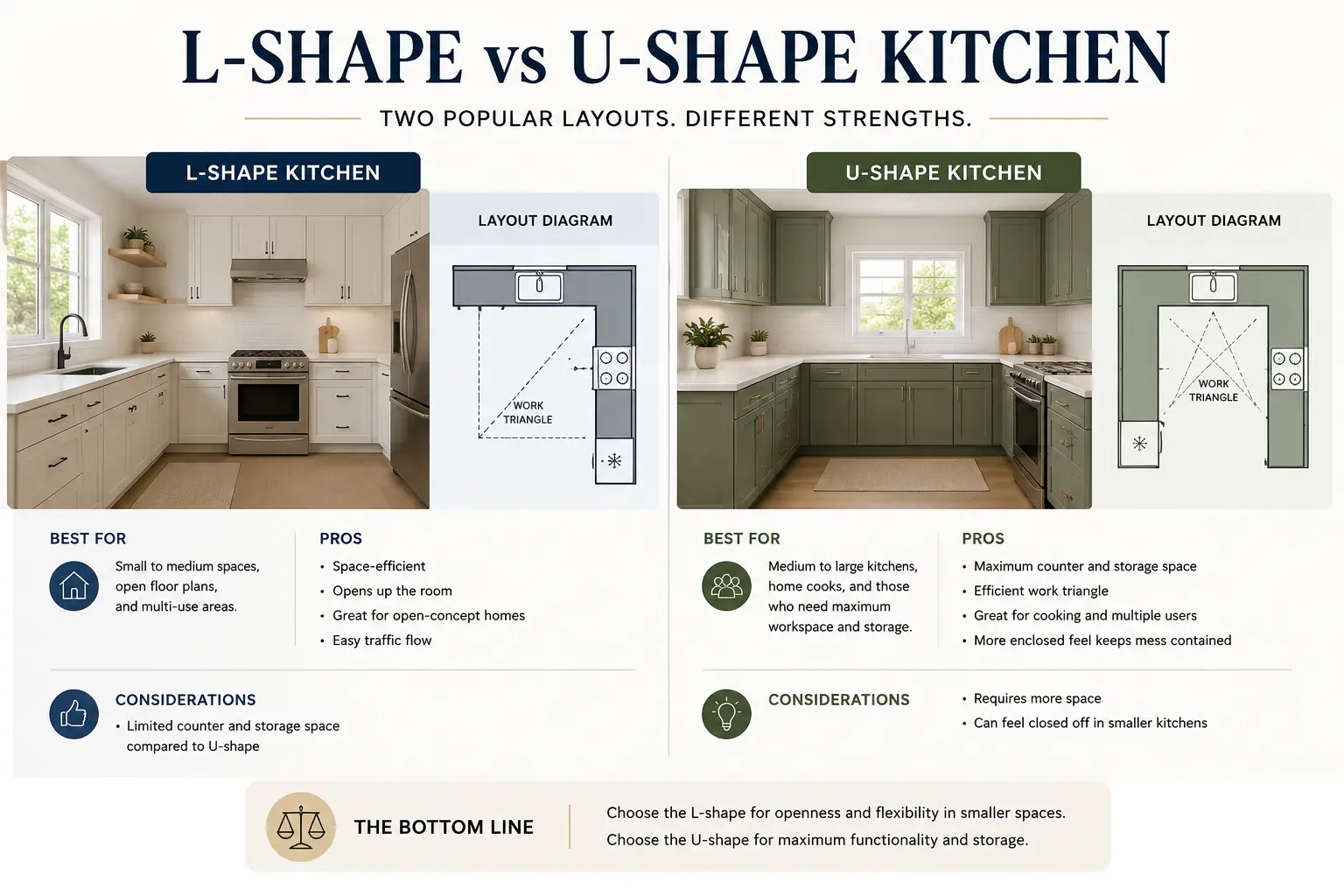
An L-shaped modular kitchen uses two walls that meet at a corner — forming, as the name suggests, an “L.” One wall is usually longer (where you’d place the cooking range, hob, and chimney) and the other is shorter (typically used for the sink, prep area, or storage).
It’s one of the most popular layouts in India, and for good reason. It works well in medium-sized kitchens, keeps the cooking zone separate from the entry area, and allows for an open feel — especially if the shorter arm doesn’t extend all the way to the wall.
The U-Shape Kitchen
A U-shaped modular kitchen wraps around three walls, giving you a continuous work surface that forms a “U.” You typically have countertop and cabinet space on all three sides, which means significantly more storage, more prep area, and a more enclosed cooking zone.
U-shaped kitchens feel more professional, more “complete,” and are often the preferred choice when the kitchen is large enough to handle the enclosure without feeling like a corridor.
The Real Question: What Kind of Kitchen Space Do You Have?
Here’s something most articles skip over — the layout is only half the equation. The other half is your kitchen’s actual dimensions and orientation.
In Udaipur, we work across a wide range of homes. Here’s what we typically see:
Apartments in complexes (Hiran Magri, Sector 4–14, Savina, Bhuwana): These usually have kitchens between 80–130 sq. ft., often in a rectangular or slightly square footprint. In most of these cases, an L-shape is the smarter default because a U-shape would make the passage too narrow — you’d need at least 4 feet of clearance between opposing counters to work comfortably, and many apartments don’t offer that.
Independent houses and older bungalows (Fatehpura, Bhupalpura, Shastri Circle area): These tend to have larger kitchen spaces, sometimes 150–200+ sq. ft., often with more than two walls available. Here, the U-shape becomes genuinely viable — and often preferable, because you get storage and prep space on all sides without the kitchen feeling cramped.
Villas and new construction (Nathdwara Road, Shobhagpura, Airport Road belt): These clients often have the most flexibility. The kitchen might be designed as part of an open-plan living area, which changes things considerably. In open kitchens, an L-shape with an island often outperforms both options — but that’s a separate conversation.
L-Shape vs U-Shape: The Honest Comparison
Let’s look at this side by side at the things that actually matter when you’re making this decision.
Storage
U-Shape wins here — no contest.
Three walls of cabinets means roughly 30–40% more storage than an L-shape of comparable size. If you have a family of four or more, cook regularly (not just occasionally), or tend to accumulate appliances, spices, and cookware the way most Indian households do — the U-shape’s storage depth is genuinely difficult to replicate with an L.
With an L-shape, you can compensate partially through a tall unit (a full-height cabinet for dry storage or a pull-out pantry), but it still won’t match the sheer volume of a well-planned U-shape.
Workflow & the Kitchen Triangle
You may have heard of the “kitchen triangle” — the imaginary triangle between your cooking range, sink, and refrigerator. The idea is that these three points should be close enough that you’re not walking miles to get from one to the other, but far enough that they don’t crowd each other.
Both layouts handle this well, but differently.
In an L-shape, the triangle is naturally efficient because everything is on two adjacent walls. The fridge usually sits at one end, the sink somewhere in the middle, and the hob near the corner or on the other arm. Movement is fluid.
In a U-shape, the triangle can be even more efficient because all three points are closer together. The risk, though, is that if the kitchen is narrow, you end up with the sink directly opposite the hob — meaning the person cooking and the person washing up are constantly bumping into each other. This is the single most common complaint we hear from clients with poorly planned U-shaped kitchens.
Verdict: L-shape is more forgiving. U-shape has higher potential but requires more careful planning.
Natural Light and Ventilation
Udaipur’s climate is something to genuinely consider here. Summers are hot and dry, and kitchens tend to get warm quickly — especially when you’re cooking.
L-shaped kitchens are generally more open. If you have a window on one of the walls, natural light and air circulation are easier to maintain. The open corner also helps heat dissipate.
U-shaped kitchens are more enclosed by nature, which means ventilation needs more thought. A good chimney with an adequate CFM (cubic feet per minute) rating becomes non-negotiable, and ideally, at least one window on the wall opposite the cooking zone helps a lot.
Verdict: L-shape has a natural advantage in Udaipur’s warm climate. U-shape needs deliberate ventilation planning.
Visual Appeal and Interior Feel
This one is subjective, but worth addressing.
L-shaped kitchens tend to look more open, modern, and “airy” — especially when paired with light-coloured shutters, handleless cabinets, and glass elements. They integrate well with open-plan homes and living rooms.
U-shaped kitchens look more structured, serious, and complete. When done well — with consistent materials, integrated lighting, and high-quality hardware — they look genuinely stunning. But they require more investment in design to avoid looking “boxy.”
If you’re going for a minimalist, contemporary aesthetic, an L-shape is easier to pull off. If you want a kitchen that makes a statement on its own terms, a U-shape has the potential to be far more impressive.
Common Mistakes to Avoid With Each Layout
L-Shape Mistakes
Ignoring the corner. The corner cabinet in an L-shape is often wasted space. Without a carousel (rotating shelf) or a magic corner unit, that deep corner becomes a graveyard for forgotten items. Always plan the corner actively.
Making one arm too short. If the shorter arm of your L is less than 3 feet, it becomes functionally useless as a work surface. Either extend it or convert it into a breakfast counter with seating, which actually works beautifully in many Udaipur homes.
Placing the fridge in the corner. The corner of an L is the least accessible spot in the kitchen. A fridge there means you’re awkwardly reaching around the door every time you open it. Always place the fridge at an open end.
U-Shape Mistakes
Too narrow a passage. This is the big one. If you have less than 36–42 inches of clearance between the two parallel counters, the kitchen will feel like a corridor. 48 inches is ideal. Measure this before committing.
No visual break. Continuous upper cabinets on all three walls can feel oppressive. Break them up with open shelving, a section without upper cabinets above the sink (great for a window), or glass-front shutters on one wall.
Misplacing the hob. In a U-shape, avoid placing the hob on the wall directly opposite the entrance. It’s a safety concern and makes the kitchen feel claustrophobic when cooking.
So, Which One Should You Choose?
Here’s a simple way to think about it:
Go with an L-Shape if:
- Your kitchen is between 80–140 sq. ft.
- You have one long wall and one shorter adjacent wall
- Your kitchen opens into a living/dining area
- You want a contemporary, open feel
- You cook regularly, but not on a restaurant scale
Go with a U-Shape if:
- Your kitchen is 150 sq. ft. or more
- You have three usable walls with at least 4 feet of clearance in the middle
- Storage is a high priority (large family, lots of cooking)
- Your kitchen is a separate, enclosed room
- You’re willing to invest in good ventilation
And if you’re still unsure? The best thing you can do is get a proper site visit done. Measurements on paper and measurements in actual space feel very different. At Akaay Interio, we do free consultations at your home — we’ll bring samples, take measurements, and walk you through both options with 3D visualizations before you commit to anything.
A Note on Materials and Budget
Whichever layout you choose, the materials you pick will affect both the final look and the long-term durability — especially in Udaipur’s climate.
For cabinet carcasses, we recommend HDF-HMR (High Moisture Resistant) boards over standard particle board. Udaipur’s monsoons, while shorter than those of coastal cities, do cause humidity spikes that standard boards don’t handle well over time.
For shutters, the most popular choices we see in Udaipur are acrylic (high gloss, easy to clean, very contemporary), laminate (durable, huge variety of finishes, more budget-friendly), and PU paint finish (the premium option — smooth, seamless, and exceptionally beautiful when done right).
Hardware — hinges, drawer channels, soft-close mechanisms — is where you should never cut corners. Good hardware from Hettich or Häfele costs more upfront but saves you from constant repairs down the line. Bad hardware on an expensive kitchen is like putting cheap tyres on a good car.
Final Thoughts
The L-shape vs U-shape debate doesn’t have a universal winner. What it has is context — your kitchen’s dimensions, your cooking habits, your budget, and your design preferences.
What we’ve seen across hundreds of kitchens in Udaipur, Bhilwara, Kishangarh, and beyond is that the homes that end up with kitchens they genuinely love are the ones where the layout decision was made after a proper site visit, a real conversation about how the family uses the kitchen, and a design process that put function first and aesthetics second.
If this article helped you think about your kitchen a little more clearly, that’s exactly what it was meant to do. And if you’re ready to take the next step — whether you’ve made up your mind or still have questions — our team is happy to visit, measure, and guide you through the whole process at no cost.
Book a Free Consultation with Akaay Interio →
Akaay Interio is a modular kitchen and home interior design brand based in Udaipur, Rajasthan. We design and manufacture modular kitchens, wardrobes, vanities, and complete home interiors for clients across India. Our facility is located at the RIICO Industrial Area, Amberi, Udaipur — 313001.